
Sevilla lodge official La Liga complaint over alleged Real Madrid broadcast bias
Sevilla FC have lodged an official complaint with La Liga, accusing broadcasters of bias towards Real Madrid during their 4-1 defeat. The row erupted after a production chief admitted to deliberately withholding replays of an Arda Güler elbow, sparking fears of technological manipulation.

Sevilla FC's 4-1 defeat to Real Madrid at the Santiago Bernabéu was far more than a mere loss on the pitch; it immediately ignited a fierce legal and media battle. By lodging an official complaint with La Liga, the Andalusian club have directly challenged the integrity of the competition, pointing to four pivotal, controversial incidents that were allegedly ignored or biasedly handled by the broadcaster.
Crucially, this disparity appears to be more than a technical glitch, pointing instead to systemic interference after a questionable relationship between Sergio Carranza Lezcano, La Liga's head of TV production, and Real Madrid TV was exposed. This scandal has not only left Sevilla FC furious but has also cast a shadow over the transparency and professional ethics of Spain's top flight.
Four controversial incidents: When TV camera angles only served Real Madrid
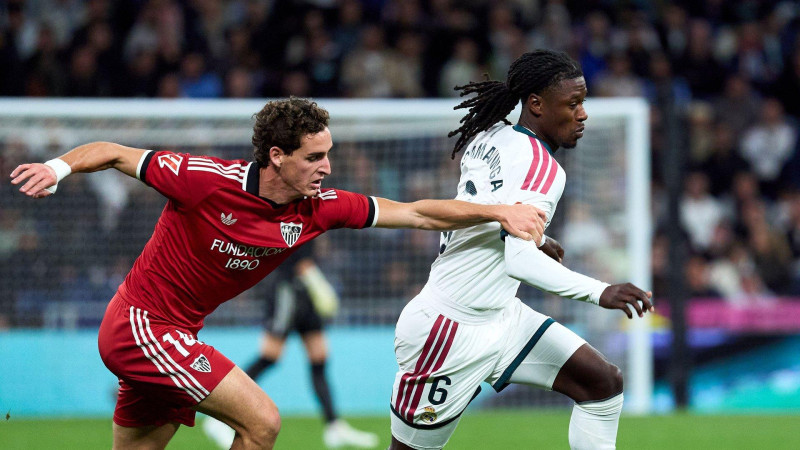
The broadcasting bias was starkly evident across four game-changing moments. First, a highly sensitive clash between Marc Cucurella and Peque that could have yielded a penalty for Sevilla FC was completely ignored and denied a replay. More seriously, Arda Güler's 25th-minute elbow to Peque's face was only shown from a distant angle without any close-up zoom, helping him escape a red card before he went on to score the opener in the 30th minute.
The sense of injustice deepened when a clear foul by Ibrahima Konaté on Robbie Ure, occurring just before Sevilla conceded their second goal, was completely cut from the live broadcast. Conversely, Kylian Mbappé's penalty was meticulously dissected from multiple crystal-clear close-up angles, exposing what Sevilla view as blatant broadcaster bias in favour of Real Madrid.
Shocking admission from production chief sparks conflict of interest fears

The scandal reached a boiling point when Sergio Carranza Lezcano, La Liga's head of TV production, made a shocking admission on COPE radio. He confessed that the production team had actively decided not to broadcast a close-up of Arda Güler's foul—a move that directly compromised the sporting integrity of the match.
This admission immediately sparked allegations of a backroom conflict of interest, given that Lezcano had previously spent six years working for Real Madrid TV. Armed with this evidence, Sevilla FC have accused La Liga of deliberately editing controversial incidents out of the official match highlights to distort the truth.
Sevilla's legal action and the future of VAR in La Liga

In response to these systemic failures, Sevilla FC have officially demanded that La Liga hand over 100% of the raw audio-visual footage from the match to prepare for an upcoming legal challenge. This is no mere knee-jerk reaction, but the opening salvo in a direct legal battle to protect club fairness.
The Andalusian club's decisive action has exposed a fatal flaw: the integrity of VAR in La Liga is being compromised by selective television angles. When VAR officials can only make decisions based on footage curated and manipulated by a production team, the league's credibility is severely eroded, plunging the future of refereeing technology into a deep crisis of faith.
Editorial perspective
This scandal transcends a standard sporting dispute, highlighting an alarming reality where broadcasting power can indirectly dictate match outcomes. When camera angles cease to be objective tools and instead become instruments for shaping public opinion and manipulating VAR, the very foundation of sporting fairness is severely shaken.
Deliberate behind-the-scenes production interference not only severely damages La Liga's reputation but also sets a dangerous precedent for modern football. In your view, is La Liga genuinely biased towards Real Madrid through selective camera angles, or was this simply a technical error?

Comments